Comparing the Orthodox and Catholic approaches to Mary, the Mother of God
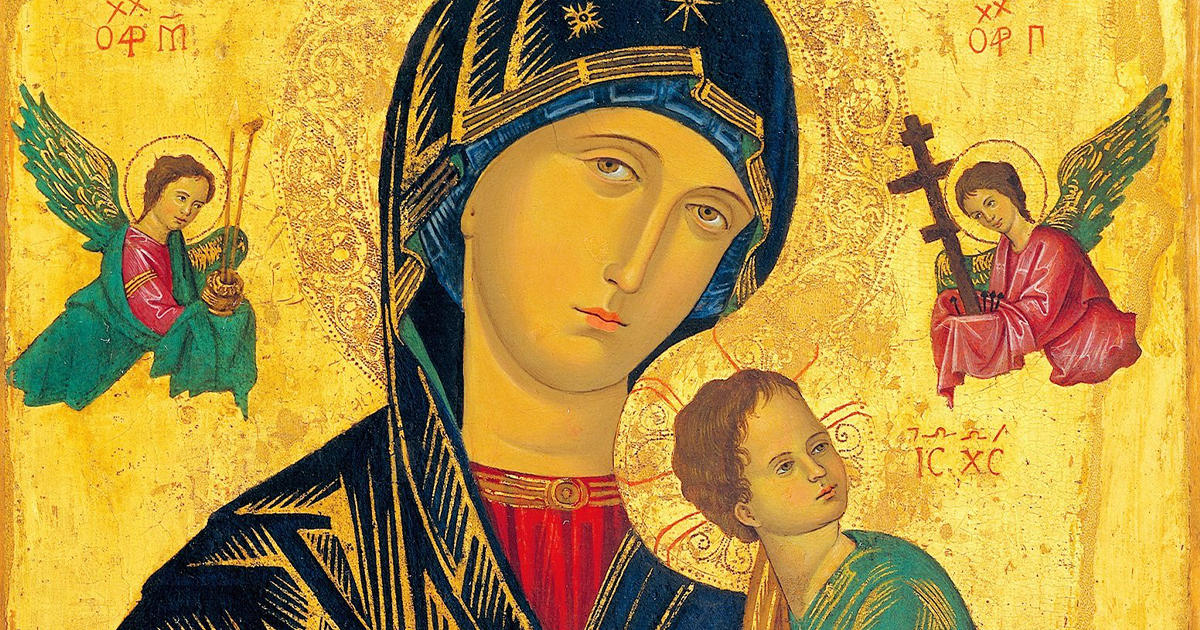
Today Orthodox Christians celebrate the Feast of the Dormition (or “The Falling Asleep”) of our Most Holy Lady the Theotokos and Ever Virgin Mary, while Roman Catholics celebrate her Assumption into heaven, body and soul.
Let’s compare the two approaches.
Regarding the Catholic doctrine of Mary’s being assumed body and soul into heaven, is this true? Perhaps. It is a mystery. But there are no relics of the Holy Virgin, no fragments of bone or other portions of her body, as there are of other saints. We have only The Holy Girdle (Soonoro), her Holy Belt. But whether she was or was not assumed is not a matter essential to our salvation. Therefore, it is not for us a matter of doctrine.
Both Roman Catholic and Orthodox Christians venerate the Mother of God as our Mother and the most powerful of the saints. But while some Catholics maintain that Mary did not die but was taken body and soul into heaven, we Orthodox affirm her Dormition, her “falling asleep”, her death and resurrection. For unlike her Son our God who died voluntarily, she died involuntarily, as all mortals must.
Yet Catholic doctrine maintains that Mary is fundamentally different from all other human beings. For according to The Catechism of the Catholic Church (paragraph 966), she was “preserved free from all stain of original sin”.
And there’s the rub. For whatever differences exist in our theologies concerning Mary come down to how we understand original sin, the sin of Adam, which we Orthodox call The Ancestral Sin (Propatorikon Amartema). This is Adam’s unique, personal sin which brought death into the world. We Orthodox say that we do not sin with Adam, as sin is personal. We do not participate in anybody’s sin, including Adam’s, unless we freely decide to do so—although we are inclined to sin. All of us are so inclined. All of us find it so easy to fall into sin. And why is this? It is not because we are fundamentally bad—indeed, being created in God’s image, we are fundamentally good! No. We sin because we’re mortal and weak, and this weakness, our mortality, is inherited from Adam. Mortality is in our blood. Death is in our blood. It is, as we say, our amartia, our “fatal flaw”. And Mary, being human by nature and just like us, needs to be saved from death by her Son, our God. Just like us, she must die and be born from above— resurrected by our God.
And yet Mary’s cooperation with the Holy Spirit was so pure that she bore God in the Flesh: As she said to God’s emissary the Archangel Gabriel, “Be it done to me according to thy word”. And so it is that Mary gave birth to God the Word, having been purified of all personal sin. But for our different understandings of sin, both Catholic and Orthodox Christians affirm this.
Some Protestant do not find Scriptural support for venerating the Mother of God as Catholics and Orthodox Christians do. Their approach to the New Testament can be literal, and they fail to see that Mary figures prominently in the Old as the Theotokos (“the God-bearer”). For she is there as The Burning Bush (Exodus 3:1-10) and the Ark of the Covenant (Exodus 25:10-22). She is prefigured as Aaron’s Rod which sprouted miraculously (Numbers 17:1-11). She is the Ladder of Jesse, stretching from earth to heaven, on which God descended to earth (Genesis 28:10-12), and she is The Living Tabernacle where the glory of God dwells (Exodus 40:34). She is The Ark of Holiness (Ps. 131.8), and she is The Holy of Holies (Leviticus 16:32-34) into which the Eternal High Priest Christ entered (Hebrews 9:1-7).
All Christians are called to venerate Mary, the Mother of God—Theotokos, “the God-bearer”. In fact, St. Gregory of Nazianzus, one of the most important theologians of the early Church—who was acclaimed by the Fathers of the Council of Chalcedon as “Gregory the Theologian”—said this in the year 379: “If someone does not uphold that the holy Mary is Theotokos, he is separated from divinity” (Letter 101, PG 37, 177C). For how can we have God as our Father if we do not have the Theotokos as our Mother?
By virtue of her calling, Mary is elevated above all of creation. She is indeed “more honorable than the Cherubim, and more glorious beyond compare than the Seraphim, who without defilement gave birth to God the Word”, as we say in our Hymn to the Theotokos. Some say this prayer every day.
Now let me share with you the earliest known prayer to the Theotokos, dating to approximately 250 and located on a fragment of papyrus. This prayer appears to be from a Coptic Christmas liturgy or a Lenten vespers service. Let us say this prayer today with all our heart:
Beneath thy compassion, we take refuge, O Theotokos: do not despise our petitions in time of trouble, but rescue us from dangers, only pure one, only blessed one.
Fr. Paul Martin
Annunciation & St. Paraskevi Greek Orthodox Church
New Buffalo, MI