
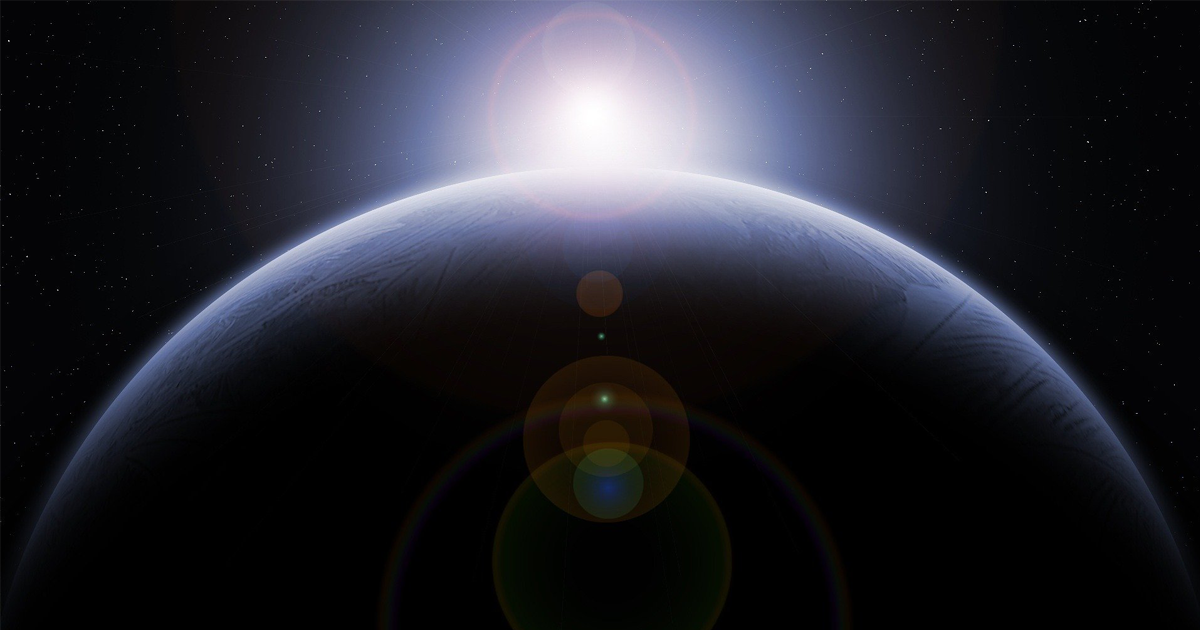
Remember that day when America was all abuzz? It was April 8 last year. Everyone was talking about the solar eclipse, waiting for that magic moment and wanting to see—but how? How can one look and not be blinded? Some purchased special glasses that are thousands of times darker than sunglasses, others built themselves pinhole projectors. But no one with any sense looked with naked eyes at that solar eclipse. Those foolish enough to do that were surely blinded.
What is it about solar eclipses that fascinates us? Is it that they happen once in a blue moon? Is it because they seem at once both natural and supernatural? Probably. But I think it all comes down to our fascination with light, with darkness—and with God.
The saints say that God is light. In Him there is no darkness at all, they say, and they should know. But how do they know? How do they see God? If the sun is thousands, millions of times brighter than any light known to man, God is billions, trillions, quadrillions of times brighter—infinitely brighter, even when “eclipsed”—that is, when all that is “down here below” is dark. When God’s light seems to have departed and we are in the dark, He is still up there, shedding His warmth, His light and life upon us, looking down on us, looking in us. Christ tells us that light is even in us—His light. We who see with the eyes of faith know this. In a manner of speaking, we see in the dark.
We employ the metaphor of the sun when speaking of God. Just as no one can look directly on the sun or a solar eclipse, so no one can look on the face of God and live. Think of Moses. He was given to see God’s back as He passed before him, but not His face. Think of the Apostles Peter, James, and John, who, on Mount Tabor, were dazzled by the transfigured light of God’s Human Face and had to turn away, lest they be blinded. That light was so intense it must have been like darkness to them.
I think God is like a solar eclipse to us. Just as the sun is the source of light—that warmth that sustains all of life—so is God. We bask in His warmth—His grace, His energies, light and life—even when our worlds are dark. But we’ll never draw near the source of His divinity, His nature, “the sun”. The divine nature is absolutely beyond us. To us, it is like the eclipsed sun—unapproachable, untouchable. Dark.
And yet the saints have seen God—not His nature, mind you, but His light, His “garments”. They see Him as transfigured, dazzling light—with their transfigured, corporeal eyes, no less. And they say that this divine, uncreated light is in all of creation, although few are given the grace to see. But those given to see are themselves in that light. It is impossible to see God’s light, the saints say, unless one is in that light.
And being in that light, the saints on earth look and see—but only fleetingly and darkly, St. Paul says, as through a dark glass—a glass infinitely darker than ordinary sunglasses. And then they return to this eclipsed world of ours, until such time as they become one with God’s light in the hereafter:
For now we see through a glass, darkly; but then face to face: now I know in part, but then shall I know even as also I am known (1 Corinthians 13:12).
So say the saints, and I take their word for it. But aren’t we all called to become saints? Aren’t we all impelled to look and see?
Aren’t we all called to become one with that divine light?
Fr. Paul Martin
Annunciation & St. Paraskevi Greek Orthodox Church
New Buffalo, MI